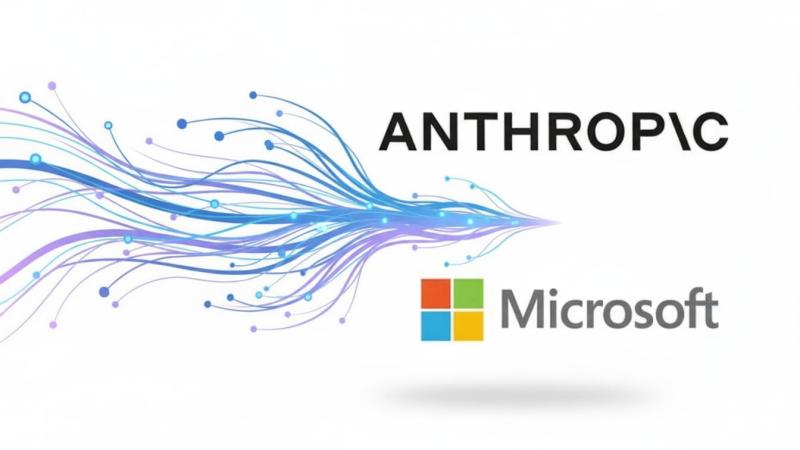
The AI race has taken another interesting turn. Microsoft is now integrating Anthropic's Claude technology more deeply into Microsoft 365 Copilot, a move that suggests the market may be shifting away from a single dominant AI provider and towards a more competitive, multi-model future.
For the past few years, OpenAI has largely been seen as the face of the generative AI boom. ChatGPT became the product everyone knew, and Microsoft built much of its AI momentum around that partnership. But Anthropic has been gaining ground, particularly in enterprise circles, where safety, control and practical business use cases matter just as much as raw hype.
That is why Microsoft's latest direction matters. Rather than backing just one AI system, it is increasingly presenting Copilot as a platform that can use different models for different jobs. In that world, Anthropic is no longer just "another AI company". It becomes one of the few serious contenders with a real chance of shaping how business users interact with AI every day.
Why Anthropic is suddenly looking stronger
Anthropic has built a reputation around enterprise-friendly AI. Its Claude models are often discussed in terms of reasoning, document handling, coding support and safer behaviour. Those qualities may sound less flashy than consumer chatbot headlines, but they are exactly the sort of things large organisations tend to care about when rolling AI into real workflows.
Microsoft's embrace of Anthropic is also significant because it gives Claude access to one of the most important distribution channels in modern software: workplace productivity tools. If Claude-powered experiences become embedded in the software people already use for email, documents, spreadsheets, meetings and internal knowledge, Anthropic's influence could grow very quickly.
That does not automatically make Anthropic the new market leader. OpenAI still has a huge brand advantage, a major developer ecosystem and enormous consumer reach. But leadership in AI may no longer be about who has the loudest chatbot. It may increasingly be about who becomes the most trusted layer inside business software, cloud platforms and developer tools.
The bigger shift - from one winner to many
The more interesting story may be that the AI industry is maturing. Early on, it was easy to talk about the race as if one company would simply "win". Now the market is starting to look more like cloud computing or search advertising: a few heavyweight players, overlapping partnerships, and constant competition for the most valuable business use cases.
That matters because it changes how companies buy technology. Businesses may not want to lock themselves to one model vendor. They may want one AI model for drafting, another for analysis, another for coding and another for internal agents. If that happens, the future of AI will not belong to a single brand. It will belong to the companies that can plug into real workflows and deliver measurable value.
What this could mean for web developers and digital agencies
For web developers, the rise of Anthropic is not just industry gossip. It is part of a broader change in client expectations. As multiple major AI providers compete for relevance, AI features are becoming less of a novelty and more of a commercial expectation.
Clients are increasingly likely to ask for practical AI features such as:
- smarter site search and natural language discovery
- AI-assisted customer support and lead qualification
- automated content drafting and summarisation
- internal knowledge assistants for staff portals and intranets
- workflow automation inside CRMs, booking systems and admin tools
That creates both pressure and opportunity for agencies. On one hand, AI may reduce the value of routine production work. Clients may expect faster turnaround, fewer billable hours for basic content tasks and more automation inside every digital product. On the other hand, agencies that understand how to apply AI sensibly could become far more valuable.
The winners may be the teams that move beyond simply bolting a chatbot onto a website. Instead, they will look at business processes and ask where AI can genuinely reduce friction, improve decision-making or unlock new types of customer experience.
In other words, the competitive edge may not come from choosing "the best model" once and for all. It may come from knowing how to combine the right model, the right workflow and the right governance for each client.
A more demanding future for digital delivery
If Anthropic keeps rising, and if Microsoft continues pushing a multi-model strategy, agencies and developers may need to adapt in three ways.
First, they will need to become more model-agnostic. Building around one AI vendor could become risky if the market keeps shifting. Second, they will need to think more carefully about data privacy, compliance and reliability, especially when AI is connected to internal systems. Third, they will need to focus more on integration and product thinking, because the real value will be in how AI fits into a service, not just the model itself.
This could be especially important for smaller digital agencies. Large enterprises may have the resources to experiment with several AI providers at once. Smaller agencies will need to be sharper. They will need to identify the use cases where AI genuinely improves delivery, while avoiding gimmicks that create more cost than value.
The bottom line
Anthropic is not the undisputed leader in AI today. But it is becoming harder to dismiss as a secondary player. With Microsoft giving Claude a bigger role inside workplace software, the company is moving closer to the centre of the AI economy.
For web developers and digital agencies, that matters because the AI race is no longer happening in the distance. It is beginning to shape the tools clients use, the features they request and the speed they expect from digital teams.
The real question may not be whether Anthropic overtakes OpenAI outright. It may be whether the next phase of AI creates a market where several major players compete to power the digital experiences businesses rely on every day. If that happens, developers will not just be watching the race. They will be building on top of it.