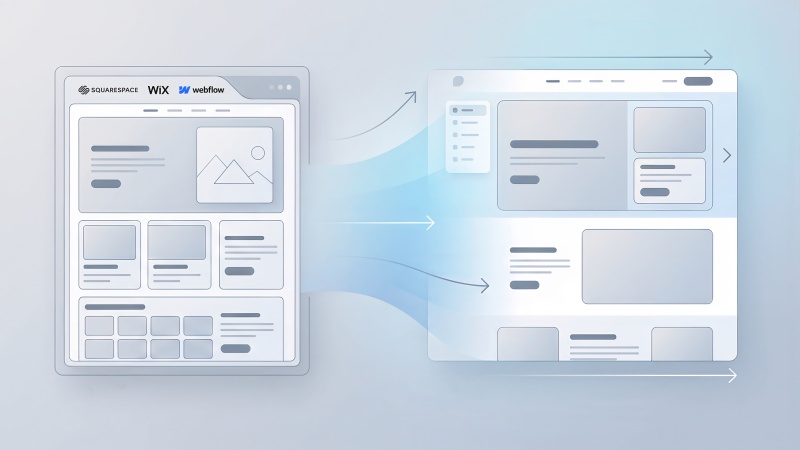
Wix, Squarespace, and Webflow have made launching a website refreshingly straightforward. For many companies, they are the right choice early on. You can get something live quickly, test ideas, and avoid heavy upfront investment.
The shift tends to happen later. Not with a dramatic failure, but with a steady build-up of small frustrations. A feature that almost works. A workaround that becomes permanent. A marketing idea that cannot quite be implemented properly.
That is usually the point where the platform starts to shape the business, rather than the other way around.
Your website is starting to dictate what you can do
If new ideas regularly come with caveats, it is worth paying attention. Whether it is a campaign landing page, a new content format, or a slightly different user journey, there should not be friction every time something changes.
We often see teams adapt their plans to fit the tool, rather than building what actually makes sense for their users or goals. It is subtle, but over time it limits both creativity and performance.
Content is becoming harder to work with
As a site grows, content rarely stays simple. You might need reusable components, structured data, or the ability to present the same content in different ways.
On many website builders, content is closely tied to page layouts. That can make updates slower, introduce duplication, and create a surprising amount of manual effort. It also makes it harder for marketing teams to move quickly, which tends to show up in missed opportunities rather than obvious errors.
Performance is good… until it isn't
For smaller sites, performance is often perfectly acceptable. But as content, scripts, and integrations build up, it can become harder to keep things fast and responsive.
At that point, improving performance is less about optimisation and more about how much control the platform gives you. If you cannot meaningfully influence load times or behaviour, you are working within a ceiling you did not set.
Integrations feel like workarounds
Most companies rely on a mix of tools, from CRMs and email platforms to analytics and reporting systems. Getting these to work together cleanly matters more than ever.
When integrations rely on plugins, patches, or slightly fragile connections, things can become difficult to maintain. It is not just a technical issue. It affects how confidently teams can run campaigns, track performance, and make decisions.
You are thinking more seriously about growth
Sometimes the trigger is not a current limitation, but a future one. Plans for expansion, new services, or more advanced marketing activity often raise questions about whether the current platform will keep up.
This is where the conversation shifts. It is no longer about what the website looks like today, but whether it can support where the company is heading next.
What this tends to mean in practice
Outgrowing a website builder is a fairly common step. It usually reflects a business becoming more ambitious, more complex, or simply more aware of what it needs from its digital presence.
The risk is not recognising it early enough. When limitations are tolerated for too long, they start to affect conversion rates, campaign performance, and even internal workflows. By the time a migration becomes urgent, it is often more disruptive than it needed to be.
A more measured approach
There is no need to rush into a rebuild at the first sign of friction. But it is worth taking a step back and looking at the bigger picture. What is the website expected to do over the next year or two? Where are the current constraints?
A move to a more flexible CMS is not about adding complexity for the sake of it. Done properly, it removes limitations, improves performance, and gives teams far more control over how the site evolves.
Ultimately, your website should support your business quietly and effectively. If it is starting to get in the way, that is usually a sign it is time to rethink the foundation.
If you are considering this kind of move, our Wix, Squarespace, and Webflow to custom CMS migration services provide a structured way to make that transition with minimal disruption.